
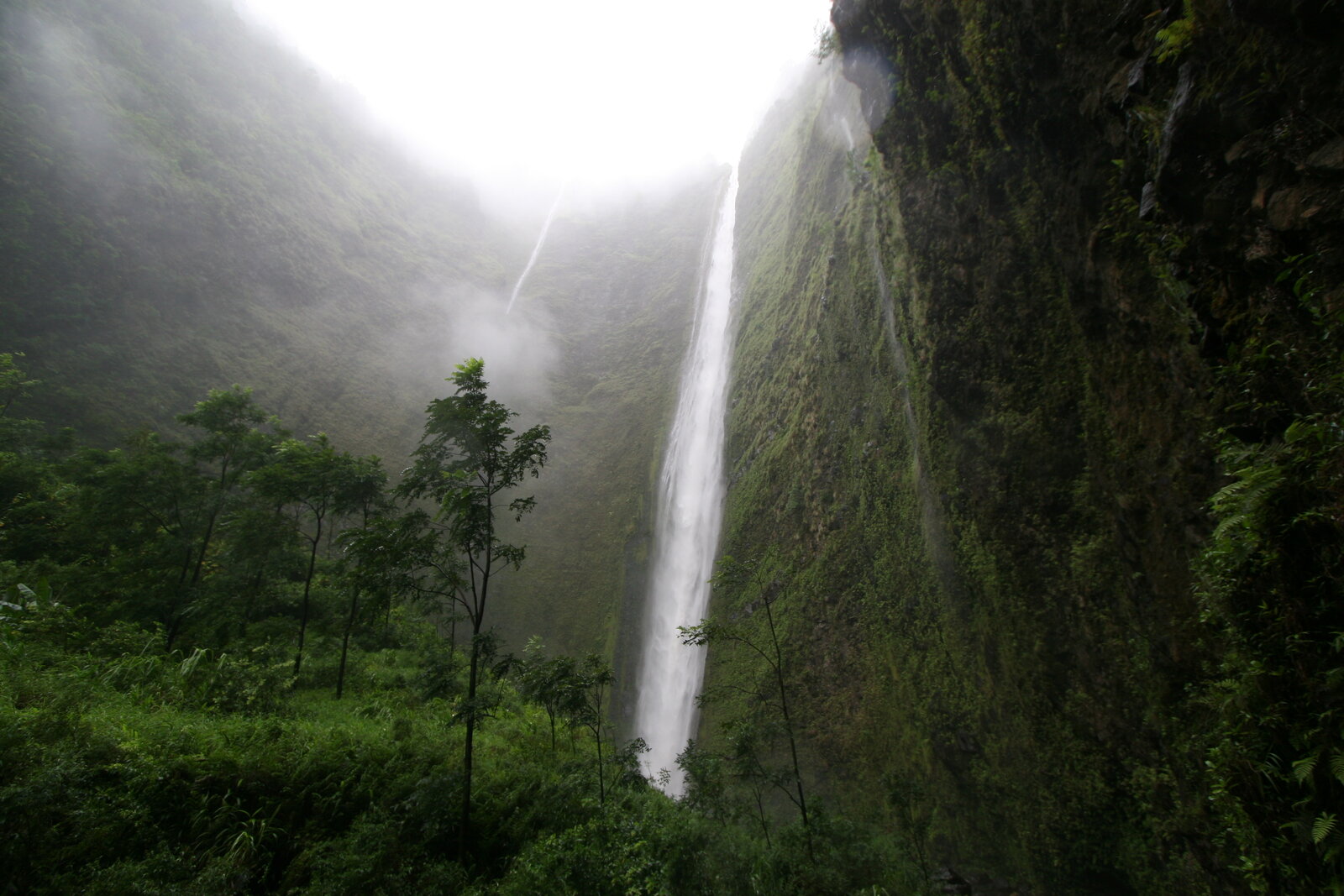
One of the tallest waterfalls in the Hawaiian Islands, dropping down the sheer back wall of sacred Waipiʻo Valley on the Big Island's Hāmākua Coast.
Hiʻilawe Falls drops from the sheer back wall of Waipiʻo Valley, a mile-wide, roughly 2,000-foot-deep valley on the windward Hāmākua Coast of Hawaiʻi Island that served as an important center of political and religious life, including the boyhood home of Kamehameha I. Fed by streams draining the Kohala mountains, it is counted among the tallest waterfalls in the Hawaiian Islands, falling in a long ribbon down a near-vertical cliff before feeding the stream that crosses the valley floor to the ocean. The valley itself remains largely undeveloped and is still used for traditional taro cultivation; the falls have no developed overlook infrastructure of their own and are viewed at a distance across the valley rather than approached directly.
Most visitors see Hiʻilawe Falls from the Waipiʻo Valley Lookout, a paved parking and picnic area at the end of Highway 240 past Honokaʻa that requires no hiking or four-wheel-drive to reach, though it draws crowds. Getting onto the valley floor for a closer vantage means descending the adjoining access road – one of the steepest public roads in the country, with grades reported up to 45% – which is effectively restricted to four-wheel-drive vehicles, guided tours, and residents; hiking in via the Muliwai Trail corridor is the other option. There is no fee to view the falls from the lookout, and how much of the drop is visible depends heavily on recent rainfall and cloud cover.
Know before you go
Waipiʻo Valley Lookout at the end of Hawaiʻi Belt Road (Highway 240), north of Honokaʻa; the valley floor itself requires 4WD, a guided tour, or hiking in.
Visible year-round; flow is heaviest and most visible after rain, and can thin out in drier summer months.
No trail needed to reach the paved lookout; descending into the valley for a closer view involves a very steep access road or the Muliwai Trail.
Free to view from the lookout.
The lookout itself is paved and reached by car, but there is no accessible route down into the valley.
2026-10-13. Conditions and requirements can change; confirm with the land manager before travelling.
Sources & further reading
- Big Island Visitors Bureau – Waipiʻo Valley Lookout ↗
- Hawaiʻi Tourism Authority (Go Hawaii) – Hāmākua Coast ↗
- USGS Geographic Names Information System (GNIS) ↗
This is a researched visitor guide, not a claim that our editors have personally visited. Trail conditions, permits, and access can change.