
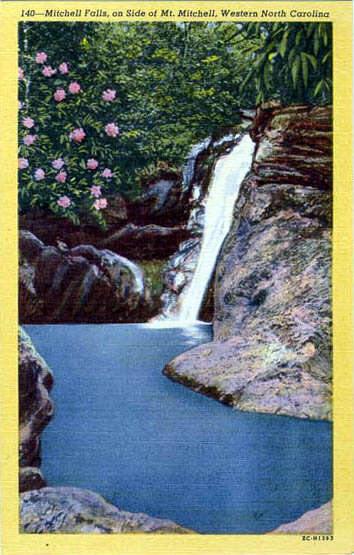
A 25-foot falls on Mitchell Creek in Yancey County, historically notable as the site where geologist Dr. Elisha Mitchell died in 1857, but located on private land with no public access today.
Mitchell Falls is a roughly 25-foot, near-vertical drop on Mitchell Creek into a small, deep pool, at an elevation of about 4,480 feet in Yancey County's Black Mountains, part of the French Broad River basin. Its principal significance is historical rather than scenic: it is the site where Dr. Elisha Mitchell — the UNC professor who first measured the height of the peak now called Mount Mitchell — fell to his death on June 27, 1857, while trying to verify his earlier survey. A circa-1909 postcard view of the falls survives in historical photo archives, reflecting its longstanding local notoriety as the site of his death.
Despite that historical weight, Mitchell Falls is today on private property with essentially no public access; obtaining permission to visit is considered highly unlikely, and trespassers risk prosecution. There is no maintained trail, parking area, or interpretive site at the falls itself — visitors interested in the Elisha Mitchell story are instead directed to Mount Mitchell State Park, where a monument marks his grave near the summit, well away from the falls where he died.
Know before you go
No public access — located on private property; permission to visit is highly unlikely and trespassing may be prosecuted.
Not applicable given lack of public access.
None maintained; not open to hikers.
Not applicable.
Not applicable — the site is not open to the public.
2026-10-15. Conditions and requirements can change; confirm with the land manager before travelling.
Sources & further reading
- ncwaterfalls.com - Mitchell Falls entry (Yancey County, 25 ft, Mitchell Creek, elevation 4,480 ft) ↗
- List of waterfalls in North Carolina (Wikipedia) ↗
- File:Colormitchellfalls.jpg (Wikimedia Commons, 1909 postcard) ↗
- USGS Geographic Names Information System (GNIS) ↗
This is a researched visitor guide, not a claim that our editors have personally visited. Trail conditions, permits, and access can change.